ADAPTIVE OPTICS PERFORMANCE
The system is presently functioning in all modes but there is substantial work remaining to make it routinely usable with low overhead. We have had 5 engineering runs with the system and as of the last run we have been able to achieve performance consistent with the planned error budget. The first run was primarily an installation and mechanical fit run. This run was complicated by the fact that when AO was installed the new guider and new instrument-mounting spool also had to be installed. Since a functioning acquisition/guider camera is mandatory for telescope operations the bulk of the first two runs was spent working on the guider. Run 3 had very poor seeing yet the AO system worked quite well bringing images that were about 1-1.5 arcsec FWHM down to about 0.4-0.5 arcsec achieving a Strehl ratio of about 8%. Figure 1 gives an example of this performance. All three upper images are scaled the same and all three are 10 second integrations. The image on the left is with the AO loop off. The middle image is with the AO loop on and the third image is with the AO loop and the TT loop on. The pixels are about 0.055 arcsec. The peak height is improved by about a factor of 4 and the image area decreased by about a factor of 4. All three images were taken in K'.
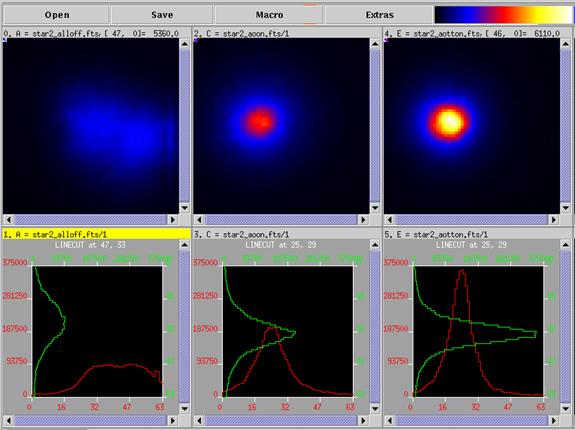
Figure 1
On the fourth and fifth runs we had much better seeing (0.8 arcsec or better). The AO system was able to deliver about 0.18 arcsec images at K in a 30 second integration. The figure below shows the dramatic improvement in the Strehl ratio during the last engineering run.
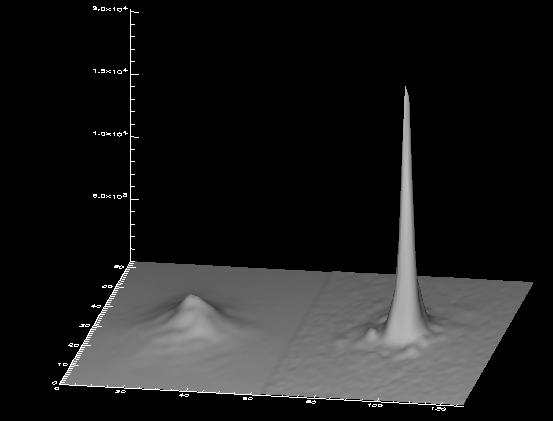
Figure 2. Image on the left shows the seeing with the AO optics removed from the light path which has a FWHM of about 0.5 arcseconds. The image on the right is with the AO system inserted and the loop closed. Both images are scaled the same. The Strehl of the AO corrected image is about 26% with a FWHM of about 3.5-4 pixels (0.056 arcseconds/pixel)
The sensitivity is about as expected. We measure around 200 counts/cycle on a 7th magnitude star with 0.263 millisec per cycle. This would get us to a signal to noise of one at 12-13 mag. Corrections will still be possible after that level but the improvement will decrease after around 12 mag. This must be verified at the telescope.
The diffraction limit for the IRTF at K is about 0.18 arcsec. Our goal is to achieve images that are around 0.20 at K with a Strehl of 20%-30%. With this last run we have met this goal but we must now prove that we can meet it routinely and with reasonable observing efficiency.
AO Tasks Remaining in
Preparation for Shared-risk Observations
We have advertised AO as being available in shared-risk mode starting in April 2003. In preparation for this the main remaining tasks are:
1) To complete our understanding of the system and optimize its performance.
2) To integrate the AO system with the facility instruments and the TCS so that we can support beam switches, dithers and offsets while the loop is closed.
3) Program the steering mirror to support differential track rate observations such as guiding on Europa while observing Io.
4) Make the system easy to use and minimize the time overhead in setting up the system.
Once we are satisfied with the NSFCAM performance, we will offer AO with SPEX.